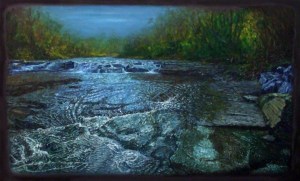
I just heard that a recent painting was published in the this month’s issue of Gray’s Sporting Journal (see above) and a couple of weeks ago I learned that an essay I wrote about my Aesthetics of Death Series and a couple of paintings would be published in the March issue of the Drake magazine. The Drake’s website will also be showing more of the paintings from the series.
Category / Recent Postings
Artwork in Italian Rod Making Magazine
This past summer, we took our kids to Italy to attend an exhibition of my work at the American Embassy in Vatican City (Holy See) in Rome. As part of the trip, we went to Pompeii, Tuscany (San Sano), Florence and Venice. Before we went, I set up a guided fly fishing trip in Tuscany for my son and I on the Tiber River. I was very excited to connect with a different part of Italy and to expand my research on my Biological Regionalism Series. The series uses videos, paintings and artifacts to connect audiences to local and global environment.
I was very fortunate that Janeil found Moreno Borriero as our guide (http://www.mbrods.it/) while she was researching our trip. When I went to his website, I noticed that we shared interest in conservation and fly fishing and we even looked similar: short, stocky and handsome.
During our time on the Tiber River, we had an opportunity to discuss our lives and interests and we were soon on the topic of the bamboo rod making magazine that he was instrumental in creating. Below is a link to the publication that featured some of my paintings from the Catskills, Bamboo Journal. The magazine is published by the Italian Bamboo Rodmakers Association.
The highlight of the day was watching my son standing in the headwaters of the Tiber as he cast to rising fish. It is one of the many memories from the trip that is embedded in my mind.
Great trip to the Grande Ronde River in Oregon
This past October, a group of friends and I went to meet an old friend, Jad Donaldson, who had become an accomplished guide in the Northwest. This was a wonderful opportunity to catch up while continuing with my research on my recent body of work called Biological Regionalism. The series incorporates landscapes, paintings and videos of specific areas around the world and the indigenous fish species found in its waters. When the series is exhibited together, it tries to connect audiences with local and global environments.
Here is a link to the video I created to document the trip for the gang:
Steelhead trip to Grande Ronde, Oregon from Alberto Rey on Vimeo.
Brookies into Canadaway Creek!
Here’s a few images and two videos documenting our recent outings into Canadaway Creek this past Spring and Fall. They featured a few children, community members and mentors from S.A.R.E.P. Youth Fly Fishing Program who were able to come help us in our efforts to repopulate Canadaway Creek with brook trout. Our good friend, Mr. Steve Welk from Whispering Pines Hatchery, was on hand to provide a short lesson on the brookies’ distinguishing physical traits. Brook trout populations had been eliminated in the stream but due to the program’s efforts and new initiatives by the DEC, we are now seeing brook trout throughout the stream and in tributaries such as Clinton Brook. Brook trout populations have been eliminated or greatly reduced throughout almost half of their historical habitat in the eastern United States and their populations remain strong in only 5 percent of their original habitat.
In 2006, S.A.R.E.P. Youth Fly Fishing program made a large investment to try to rectify the situation by purchasing equipment to raise brook trout in a Fredonia Middle School science classroom and by doing additional fundraising to supplement the numbers of brook trout we were able to raise by ourselves. We have worked closely with the DEC and have electro-shocked the stream during the warmest months in the summer to find where the brook have survived. Thanks to their efforts, we have been able to find the coolest spring waters with a thick canopy in fairly inaccessible locations that are best suited to support the introduction of the these trout. With the support of the Orvis, Patagonia World Trout Fund, Dreamcatcher Foundation and private donors, we have been able to continue our educational and conservation programming.
Reintroducing Brook Trout into Canadaway Creek in March 31, 2012 from Alberto Rey on Vimeo.
Brookies into Canadaway! from Alberto Rey on Vimeo.
Artwork in Gray’s Sporting Journal – March/April 2012
Here’s a two-page spread of a painting titled Biological Regionalism: Brook Trout III, Catskills, United States which appears in next month’s Gray’s Sporting Journal. The painting was created for a solo exhibition at the Chace-Randall Gallery in Andes, New York. This wonderful little gallery has been representing my work for the past few years and has been exhibiting my paintings devoted to the trout and char species found in the Catskill streams. Check out their site for other examples of work from recent exhibitions.
Two exhibitions at Robert Wesleyan College, Rochester, NY
I will be participating in two exhibitions at Robert Wesleyan College between January and April in 2012. This is a rare opportunity to display a large representation of past works while also displaying new site-specific work in two galleries on one campus.

Cuban Portraits Series: Antonio, Miami, Florida
Oils on plaster
15x12x2
1. The first presentation, “Reflections on Culture and Memories Lost”, is a solo exhibition of 26 small paintings from the past 20 years. Several of these works have never been exhibited. This exhibition runs from January 23 through to March 23, 2012 at Northeastern Seminary on the campus of Roberts Wesleyan College on 2265 Westside Drive in Rochester, NY. Contact info: 800.777.4RWC or 585.594.6802

Las Balsas (The Rafts) : I
Oils on plaster
29x17x10
2. The second exhibition will be presented between March 5 through to April 6 where I will be presenting 6 paintings in a two-person exhibition, “Realms and Origins”, at the Davison Gallery also on the campus at Robert Wesleyan College. The opening reception will occur on Monday March 12, 2012 from 5:00-7:00 p.m. with an artists’ talk at 5:30pm. This will be a good opportunity to also see the other exhibition at the Northeastern Seminary which is located in the building next to the gallery. The Davison Gallery is located on lower atrium of the Cultural Life Center on 2301 Westside Drive. For directions click here.

Biological Regionalism: Brown Trout, Four Mile Creek, Rochester, New York
Oils on Plaster
33×48

Biological Regionalism: Four Mile Creek, Rochester, New York
Oils on Plaster
33×48
In this exhibition, I will be presenting two new site-specific works from the Biological Regionalism Series as well as four other paintings from Virginia and Alaska. These works represent the specific locations and fish species found in western New York as well the east and west coasts of the United States. The male brown trout was documented in Four Mile Creek in the outskirts of Rochester. It had migrated up from Lake Erie to spawn in the small stream located next to the remains of an old gristmill/saw mill from 1806.

Biological Regionalism:Brook Trout, Big Mary’s Creek, Vesuvius, Virginia
Oils on Plaster
42×63

Biological Regionalism: Big Mary’s Creek, Vesuvius, Virginia
Oils on Plaster
33×48
Two other paintings document the threatened native brook trout population found in a small, secluded stream called Big Mary’s Creek near Vesuvius, Virginia.

Biological Regionalism:Dolly Varden, Aniak River Tributary, Aniak, Alaska
Oils on Plaster
42×63
The last pairing of paintings documents a spawning dolly varden that was documented in the Aniak River after migrating upstream from the Pacific Ocean.

Biological Regionalism:Aniak River Tributary, Aniak, Alaska
Oils on Plaster
42×63
Davison Gallery contact:
Scot Bennett,
Director, Davison Gallery
Curator, BT Roberts Memorial Hall Gallery
Bennett_Scot@roberts.edu
585.594.6441
Biological Regionalism: Selected Streams from Northern Chautauqua County, New York
The following paintings were created for the exhibition at the Octagon Gallery at the Patterson Library in Westfield from March 2-30, 2012. The reception will occur from 7-9pm on Friday, March 2 and a lecture about the work in the exhibition will be presented on Thursday, March 15th at 7pm.
In past blog entries, I have include some process shots of the development some of these paintings. I will include links to these blog entries underneath each of the images of the artwork.
Biological Regionalism:
Chautauqua Falls, Westfield, New York
Oils on Plaster
33″ x 48″
Link to more information / blog entry
Biological Regionalism: Selected Streams from Northern Chautauqua County, New York
When I first settled in this area in 1989, I remember hearing stories about the salmon runs in Canadaway Creek. It was all very intriguing but I had a new job that I needed to secure and it was six years later before I began researching the migrating fish species in the local tributaries of Lake Erie. When I did begin the research, I concentrated my efforts on the history of Canadaway Creek, the introduction of fish species into the Great Lakes, the history of towns located along the creek, regional geology, entomology, weather patterns affects on local fish’s physiology, fish biology and hydrology. Before long, I couldn’t get enough information and soon I began to befriended local biologists, Department of Environmental Conservation officers and local anglers as a way to build my resources. A couple of years later, my obsession led me to start a youth fly fishing program and, soon afterward, I became a fly fishing guide as a way to fund my obsession and to keep me out on the streams.
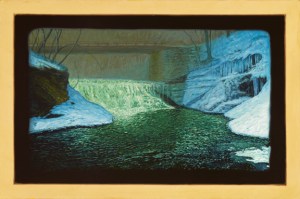
Biological Regionalism:
Laona Falls, Laona, New York
Oils on Plaster
33″ x 48″
Link to more information / blog entry
In 2000, after finishing a series of paintings on Cuban and American culture, I was ready to move into a new direction and I began the Biological Regionalism Series. The series incorporated the research I had been acquiring over the previous years and motivated me to investigate and research many other streams in western New York and the Catskills as well as bodies of water in Massachusetts, Florida, Alaska, Montana, New Mexico, Montana, Idaho, Oregon, Arizona, California, Virginia, Pennsylvania and also Wales, England, Iceland and Cuba. As my travel and exhibitions opportunities drew me further and further away from my local waters, I found little time to document the specific regional locations where I had logged hundreds of hours studying the stream’s hydraulics, observing the different holding patterns of fish through the year, guiding clients and trying my own fly patterns on migrating fish.
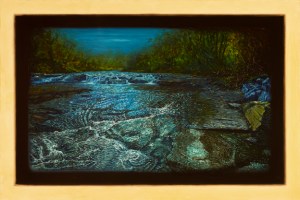
Biological Regionalism:
Risley Falls, Fredonia, New York
Oils on Plaster
33″ x 48″
Link to more information / blog entry
This exhibition provided me the opportunity to exhibit the work in Patterson Library’s wonderful architecture and collection of paintings and taxidermy specimens. It seemed like a perfect venue to exhibit these devotional paintings of some of my favorite stream locations in this area.
Biological Regionalism:
Arkwright Falls, Arkwright, New York
Oils on Plaster
33″ x 48″
More information about the Biological Regionalism Series:
Apart of the research mentioned above, my investigations also included the painters of the Hudson River School of the 19th century and their role in American society. This art movement documented the expanding American landscape and its wilderness for the general public who had little exposure or accessibility to their new environment. The study of biology, botany, geology and art was popular amongst the residents of the new country and piscatorial art and nature painting was considered a form of “high art” during this period. This art form no longer seems innovative in contemporary art although there is a dire need to rediscover the connection between nature and culture. This connection is deteriorating as most of our social and economic reliance has moved to an urban setting.
Biological Regionalism:
Mouth of Corell Creek, Portland, New York
Oils on Plaster
33″ x 48″
As our culture becomes more homogenized by mass media and consumerism, the one element that remains true to a region is its natural environment. Although we try to manipulate it to fit our needs, most landscapes and their biological inhabitants characterize a region’s nature. It is an omnipresent influence that affects a region’s people, culture and economy. The knowledge of a region’s distinguishing natural elements is being lost as generations continually become more disconnected from a lifestyle that relies on the landscape for survival and for spiritual renewal.
Biological Regionalism:
Glen Mills Falls (Old Portage Road Falls), Westfield, New York
Oils on Plaster
33″ x 48″
The regions investigated in this series are usually a short walk or drive from the exhibition venue. When a viewer experiences the installation, my hope is that they begin to create or recreate a connection to their immediate environment. In past installations of Biological Regionalism Series, I tried to reestablish this connection by reintroducing the fish and landscape that characterize a specific region. For this exhibition, I have concentrated entirely on landscapes or the depiction of the environment as a way to have the area’s resident reconnect with memories from these locations and/or to create new connections to nearby environments. I hope the exhibition can also create opportunities to discuss topics related to historical and contemporary theories of aesthetics, migration of fish species, history of these locations, environmentalism, and geological formations.
While the regions investigated are specific, the issues raised are universal.
Small Stream, Small Pool / Large Fly, Large Fish
Last year I documented a small pool full of steelhead in one of my favorite little streams. I had been meaning to put this little video together then but somehow the files got lost and I was just recently came across it.
The fly used was a 2/0 white marabou streamer with olive and black ostrich herl on the back. The silver tinsel is from a spool of yarn that I have been using for several years now. The hook had a clouser eye and four glass beads that made the fly heavy but it cames down into the water flat and fast. The barbless hook always rides up so and is fished just above the fish so that it minimizes foul hook-ups. This also provides some entertaining scenes of steelhead coming up to take the fly as you will see in the video. I usually use smaller, sparsely-tied flies as the water clears…. somethings using a size 12 hook.
New work from studio: Chautauqua County Streams, New York – Part IV
Here are a few process shots of the last painting that I will exhibiting on March 2-30, 2012 at the Octagon Gallery in the Patterson Library in Westfield, New York.
This is a painting of Risley Falls on Canadaway Creek which flows right below our home.
I have spent countless hours studying the water flow of every part of this rock formation and have very fond memories of standing in its water with close friends fishing for steelhead and with my son as he worked small dry flies for fingerlings in the summer. I rarely fish this section of the stream anymore. I not sure why. Perhaps I enjoy walking the stream more now… perhaps I enjoy swinging streamers more the last few years….perhaps I’m drawn to different sections of the stream every year…and perhaps it will always be reserved as a place to be fished with others who make it more special.
There remains something comforting about fishing a stream that you know very well. It’s like being with a dear friend who has been with you from the beginning. Nothing is ever said but the experience of being in their company is always rewarding.
The images for the painting were taken in the early fall of 2011.


You must be logged in to post a comment.