Brook trout back in Canadaway Creek!

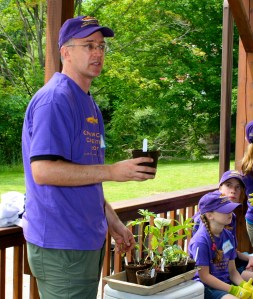
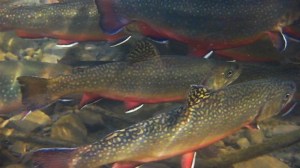
This past Saturday, the kids, community members and mentors that make up the S.A.R.E.P. Youth Fly Fishing Program met with our good friend, Mr. Steve Welk from Whispering Pines Hatchery, to introduce brook trout spawners into Canadaway Creek. We have heard reports passed down through the generations of family members catching brook trout in the stream but brook trout have not been found in the stream for close to a century due high water temperature, agriculture, riparian condition, one or more non-native fish species, urbanization and acidic deposition. Brook trout populations have been eliminated or greatly reduced throughout almost half of their historical habitat in the eastern United States according  released assessments by Trout Unlimited and a coalition of state and federal agencies. The report says brook trout populations remain strong in only 5 percent of their historical habitat in the eastern United States.

In 2006, S.A.R.E.P. Youth Fly Fishing program made a large investment to try to rectify the situation by purchasing 265 gallon tank, stand, chiller, pump and filter and place it in the Mr. Dan Lawrence’s science room. We got eggs donated from the Department of Environmental Conservation (DEC) hatchery in Randolph and we began to raise brook trout in the classroom. The following year Canadaway creek had brook trout in its waters for the first time in around 100 years. Over the years we learned a great deal about the fragility of this trout species and difficulty in raising them in a classroom. As the program continued, it became clear that we needed professional help and that we need to supplement the brook trout we were raising if we wanted to try to create a strain of brook trout that could survive in Canadaway Creek. Ever since then we have worked closely with Mr. Steve Welk.

Over the years we have tried to introduce around 400 six to nine inch brook trout in the spring and an additional 100-125 larger brookies in the fall that are ready to spawn. We have also worked closely with the DEC and have electro-shocked the stream during the warmest months in the summer to find where the brook have survived. Thanks to their efforts, we have been able to find the coolest spring waters with a thick canopy in fairly inaccessible locations that is best suited to support the introduction of the these trout. With the support of the Orvis, Patagonia World Trout Fund, Dreamcatcher Foundation and private donors, we have been able to continue our educational and conservation programming.
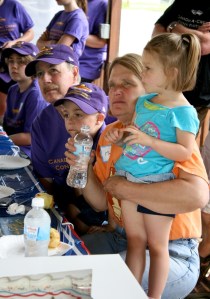
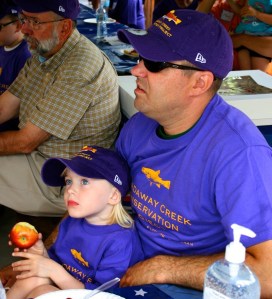
These are some of the images and short video (one minute) from our recent trip to introduce some new spawners into the stream.
 

New work from studio: Chautauqua County Streams, New York – Part II

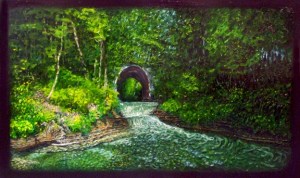
Here is the fourth out of six paintings that I am planning to exhibit on March 2-30, 2012 at the Octagon Gallery in the Patterson Library in Westfield, New York.

This is the painting of Chautauqua Creek Falls located off of Sherman Road in Westfield, New York. The falls are located upstream from town in the stream’s Catch and Release Section.

The images for the painting were taken in August 2011 during a family trip to the falls to retreat from the day’s heat. We munched on wild blackberries on the path back to the car.

New work from studio: Chautauqua County Streams, New York

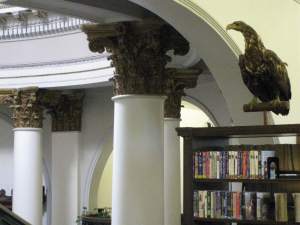
From March 2-30, 2012, I will be presenting a solo exhibition in the Octagon Gallery, which is part of the beautiful Patterson Library in Westfield, New York. I have always been a fan of the library and its architecture along with its collection of historic paintings of the Westfield and taxidermy specimens.

Over the past few years, my research and exhibitions have been outside the region so I haven’t had much of an opportunity to make paintings of some of my favorite locations that are close to home.

This is a rare opportunity for me to dedicate a good bit of time to documenting these scenes. I am planning on creating six to eight new four-foot paintings of water scenes from Westfield (Chautauqua Creek), Fredonia (Canadaway Creek), Arkwright (Canadaway Creek), and Brocton (Corell Creek) during different times of the year.

These are three of the recently finished works for the exhibition.


New work from studio: Four Mile Creek, Rochester, New York

Here’s some studio shots of some recent work for an upcoming exhibition at the Davison Gallery at Robert Wesleyan University in Rochester, New York in March of 2012.

The two paintings are of a brown trout and the stream  that was documented last year at for Mile Creek in Webster just outside of Rochester. This work is part of the Biological Regionalism Series which documents environments and fish species located near the exhibition venues. The work tries to create connections between society, culture and nature.

The Davison Gallery is located in the Kodak Atrium, Roberts Cultural Life Center, at Roberts Wesleyan College, 2301 Westside Drive, Rochester, NY 14624. The exhibition runs from March 2 -30, 2012. The Davison Gallery is open from 11 a.m. – 5 p.m. Monday through Friday; 1 p.m. – 4 p.m. Saturdays.

Upside to getting old.

Back in 1988-89 (22 years ago) before arriving here at SUNY Fredonia, I had the pleasure of teaching art at Lincoln-Sudbury High School in the outskirts of Boston, MA. The folks there were very nice to me and the students were very committed to their education. One of those curious students was a young man whose name was Josh Peters. He was always asking questions and there seemed to be a genuine interest in art outside the academic setting but I also knew that life had a way of directing one’s future and that being an artist can be a difficult career choice. I really didn’t think much about it until Josh emailed me a few years ago that he was finishing graduate school at Rutgers University with a MFA in Painting.

I was surprised by the email but very proud of his hard work and perseverance.  I’m glad that we have kept in touch ever since as I have seen him exhibit his work in China, Hong Kong, Germany as well as in major cities on the east and west coast of the United States. He is now also curating “ La Californie”, an exhibition that opens this Friday, September 9th, in Los Angeles. It is very exciting to experience his progress through his career ….maybe getting old isn’t so bad if you can stick around long enough to see your students realize some of their dreams.

He will also be exhibiting in the ‘2011 Fellows’ exhibition at the Armory Center for the Arts, Pasadena, CA and ‘The Unseen’ exhibition at the Torrance Museum of Art, Torrance, CA.

Canadaway Creek Conservation Project 2011 a big success!

Thank you all for your work in making the Sixth Annual Canadaway Creek Conservation Project a big success!

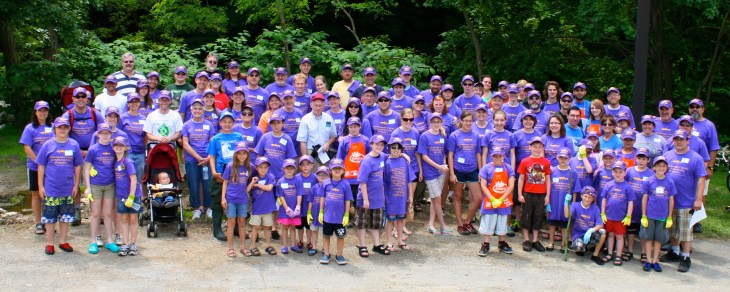
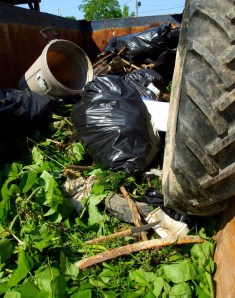
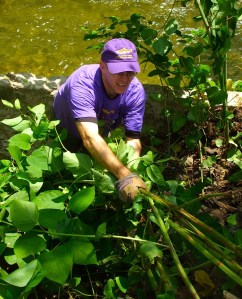
This year had record number of  participants (109!) which were all very important in planting 225 dogwoods and willow trees and almost filling  a 30 yard dumpster! We also expanded the activities this year to incorporate the removal of invasive plant species in specific sections of the stream! What a great group of volunteers!


Schedule of this year’s events:

After everyone signed in, got their t-shirts, hats, gloves and maps,

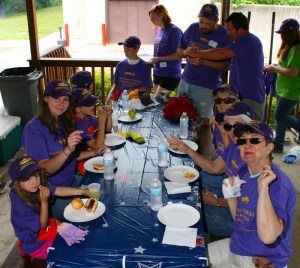
Lunch was provided for all the workers.


This year’s event was highlighted by a presention by Dr. Ted Lee, a professor from State University of New York at Fredonia, who spoke about the invasive plant species in the area and about the healthy native alternatives.

The presentation was very stimulating and gave the group a great deal to think about. Many of the the children were excited that they could identify the invasive species as they walked along the creek collecting garbage. Everyone listened attentively to Ted’s words.


After the presentation, the group broke up into teams and began planting trees,

cleaning the stream,

and removing the invasive plant species.


It was a wonderful day and we look forward to seeing everyone and their friends next year!


Sometimes nature unveils itself.

Sometimes it seems that if you spend enough time in nature, you sometimes experience something rare that brings you little closer to the mystery of nature. This mystery is the unaccessible elements that seems to move away from us as we move through its environment. There are those instances, however, when if you stay long enough and remain quiet, nature moves back and envelopes you. These are those wonderful moments that remind you that you can be part of something much larger and spiritual. It brings you peace and reminds you to come back when you begin to lose perspective.

…and then there are those times when you have a camera and have a few seconds to document the moments when nature is completely accessible.

Here are a few of those events:

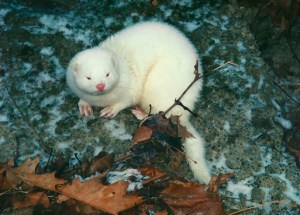
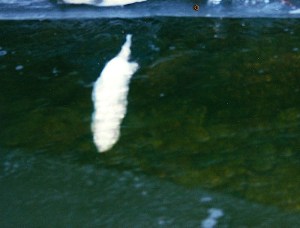
1. About 10 years ago, while fishing 20 Mile Creek in Pennsylvania in the dead of winter, a very rare white mink strolled down the bank, slid into the water and started chasing steelhead underneath the shelf ice in front of my feet.

After a few seconds of circling around the large rocks, he would slowly climb up the bank, shake himself off, look back at the fish and then slowly head back to the water to make another attempt at finding his dinner. This went on for about 10 minutes before he headed back into the woods to try another section of the stream.
He stay a few feet from me the entire time. I returned a week later and continued to do so for several years during the coldest days of the year in the hopes of seeing him/her again but always without success.

2. A few years later, while fishing a secluded section of Hosmer Creek, I had a fawn walk slowly through the woods and came out about 10 feet from me in the stream. We looked at each other for about 30 seconds and then  she slowly started moving closer to me. I was shocked and wondered how close she would get.
She didn’t seem nervous, just curious. I slowly got my camera and took this picture as she slowly turned, crossed the stream and headed back into the woods.

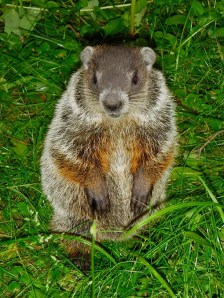
3. Around 6:30pm tonight, as I was heading home after an hour or two of scouting Canadaway Creek for a guide trip on Sunday, I took a short cut through the woods. As I turned into the trees,  a groundhog was right in front of me. He stood there perched on his hind legs patrolling the path.

After what seemed to be a few minutes of looking at each other,  I slowly searched for my camera and began taking pictures. After a couple of shots shot , I would take step toward him and take a few more pictures.

I continued to take shots until I got a couple of feet away. We continued to look at each other. The only thing moving on him was the fur on his chest as he inhaled and exhaled. After taking a short movie, I took my final step. He slowly went down on his fours and swaggered into the tall grass.


Lampreys in Canadaway Creek

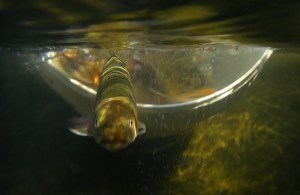
Here’s an image of lamprey in Canadaway Creek in June 2011 and here’s a movie of the same lamprey.

During the past two centuries, invasive species have significantly changed the Great Lakes ecosystem. In turn, the changes have had broad economic and social effects on people that rely on the system for food, water, and recreation.

An “invasive species” is a plant or animal that is non-native (or alien) to an ecosystem, and whose introduction is likely to cause economic, human health, or environmental damage in that ecosystem. Once established, it is extremely difficult to control their spread.

At least 25 non-native species of fish have entered the Great Lakes since the 1800s, including round goby, sea lamprey, Eurasian ruffe, alewife and others. These fish have had significant impacts on the Great Lakes food web by competing with native fish for food and habitat. Invasive animals have also been responsible for increased degradation of coastal wetlands; further degrading conditions are resulting in loss of plant cover and diversity.

Sea lamprey (Petromyzon marinus) are predaceous, eel-like fish native to the coastal regions of both sides of the Atlantic Ocean. They entered the Great Lakes through the Welland Canal about 1921. They contributed greatly to the decline of whitefish and lake trout in the Great Lakes. Since 1956, the governments of the United States and Canada, working jointly through the Great Lakes Fishery Commission, have implemented a successful sea lamprey control program.

Here’s two lampreys on a steelhead at the mouth of Canadaway back in 2006.

and here’s the results of their destruction on the fish that survive. Image from June 2011.

Check out www.flyfishergirl.com!

For the REAL fly fishing girl or woman or for that matter, any fly fisherman should check out this site!

Now listen to this and tell me if this isn’t a great story.

The website is run by Hannah Chloe Belford who is the head guide at the Damdochax River Lodge out of Smithers, British Columbia. Hannah and her mother Alice operate the lodge. Alice is the hostess, part-time guide, a certified healing touch practitioner, and a watercolor artist. Hannah is the head guide, the webmaster, an interior designer, and a graphic artist.

Alice has guided on this river for almost 30 years and Hannah for 17. Between the two, they have tailed thousands of steelhead, and countless numbers of other species. They absolutely love our jobs and careers, and would not consider doing anything other than what they do…… it’s their best lifestyle imaginable.

S.A.R.E.P. Youth Fly Fishing Field Trip – May 2011

This past May, we had a little outing with our youth group and a few community members. Along the way, we noticed some mayflies on the road.


The mentors worked with the kids on their casting before we hit the water.

We also discussed approaching the water, entomology and how to read the water before fishing.

Finn lands his first fish on a fly he tied!

On the lower pond, the brook trout were more selective but we were able to find some other beauties.

At the end of this beautiful day, we all realized that the trip wasn’t entirely about catching fish.